Backpropagation Formulated
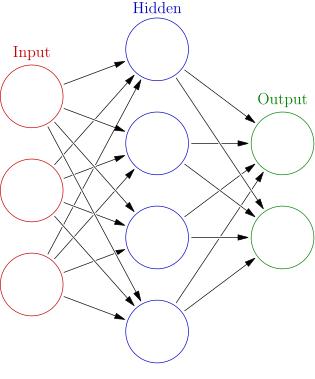
Summary: On August 31, 1974, Paul Werbos, in his Harvard PhD thesis, formally outlined the mathematical framework for backpropagation, a groundbreaking algorithm that enables artificial neural networks to learn by recursively adjusting their internal weights based on error signals.
| Historical Attribute | Milestone Registry Value |
|---|---|
| Classification Type | event |
| Chronological Date | 1974-08-31 |
| Coordinates / Location | Cambridge, Massachusetts |
| Curation Authority | Nick Hodder + MIA |
| Milestone Importance | godfather Milestone |
How does Backpropagation Formulated fit into the history of artificial intelligence?
The journey towards artificial intelligence has been a long and winding road, marked by periods of great optimism and frustrating setbacks. Early theoretical groundwork was laid by figures like Alan Turing, whose work on computation provided a theoretical basis for intelligent machines. The McCulloch-Pitts Neural Model in 1943 offered the first mathematical description of a neuron, proposing that artificial neurons could perform logical functions. This was followed by the rise of cybernetics, with Norbert Wiener's seminal work in 1948, which explored feedback loops and control systems. The advent of early computing hardware like the SNARC Neural Simulator in 1951 demonstrated the possibility of building systems that mimicked neural structures. However, these early neural models, including Frank Rosenblatt's Perceptron, were largely limited to learning from simple, linearly separable data. The critique in Minsky and Papert's "Perceptrons" book in 1969, which highlighted the limitations of single-layer perceptrons in solving more complex problems, contributed to a significant slowdown in neural network research, often referred to as the first "AI Winter" (AI Winter 1). It was into this landscape that Paul Werbos's doctoral research on backpropagation was introduced. While the field was grappling with the limitations of existing learning algorithms for multi-layered neural networks, Werbos provided a mathematically sound method for training them. His work, however, was published within his thesis and did not immediately gain widespread traction, a common fate for revolutionary ideas in times of research stagnation. The significance of backpropagation would only be truly realized nearly a decade later when other researchers independently rediscovered and popularized it, leading to the resurgence of neural networks and the development of more sophisticated AI systems.
What are the core technical achievements of Backpropagation Formulated?
The fundamental technical achievement of Paul Werbos's 1974 thesis was the formal mathematical derivation of the backpropagation algorithm. Prior to this, training multi-layer neural networks, which are more powerful than single-layer networks like the Perceptron, was a significant challenge. The core problem was how to efficiently determine how to adjust the weights (the connections between artificial neurons) in the hidden layers of the network to minimize the error in the final output. Backpropagation addresses this by employing the chain rule of calculus from differential calculus. When the network produces an output that differs from the desired output (an error), this error is not just noted; it is propagated backward through the network, layer by layer. At each layer, the algorithm calculates the gradient of the error with respect to the weights in that layer. This gradient essentially tells us the direction and magnitude of change needed for each weight to reduce the overall error. Essentially, the algorithm "blames" each synapse (connection) for a portion of the total error based on its contribution. By recursively applying this process, starting from the output layer and moving towards the input layer, the algorithm can compute the gradient for every weight in the network. This information is then used by an optimization algorithm (like gradient descent) to update the weights, thereby allowing the network to learn. Werbos's formulation provided a systematic and mathematically rigorous way to achieve this learning in networks with multiple interconnected layers, opening the door to learning more complex patterns than previously possible. This was a critical departure from earlier, more ad-hoc learning methods.
Why is the legacy of Backpropagation Formulated significant to modern computing?
The legacy of Paul Werbos's formulation of backpropagation, though initially overlooked, is monumental and forms the bedrock of modern deep learning. For nearly a decade, the insights presented in his thesis remained largely confined to academic circles, a testament to the challenges of disseminating groundbreaking research. However, its eventual re-emergence and widespread adoption, particularly around 1986 with its popularization by researchers like David Rumelhart, Geoffrey Hinton, and Yann LeCun (as seen in the Backpropagation Popularized milestone), revolutionized the field of artificial neural networks. Backpropagation, coupled with advances in computational power (like the development of GPUs, exemplified by the GeForce GPU Coined milestone) and the availability of massive datasets (such as ImageNet Database Project), became the indispensable engine for training the complex, multi-layered neural networks that define contemporary AI. From image recognition systems like LeNet Digit Classifier and AlexNet Convolutional Net to natural language processing models like BERT Language Model and large language models like GPT-3 Language Model, backpropagation is the core learning mechanism. It is the silent, powerful force enabling machines to learn from vast amounts of data, powering everything from autonomous vehicles (ALVINN Autonomous Vehicle) to sophisticated game-playing AIs (AlphaGo vs Lee Sedol). The initial underappreciation of Werbos's work underscores the often-unpredictable trajectory of scientific discovery, but its eventual impact has undeniably shaped the technological landscape of the 21st century.