David Rumelhart
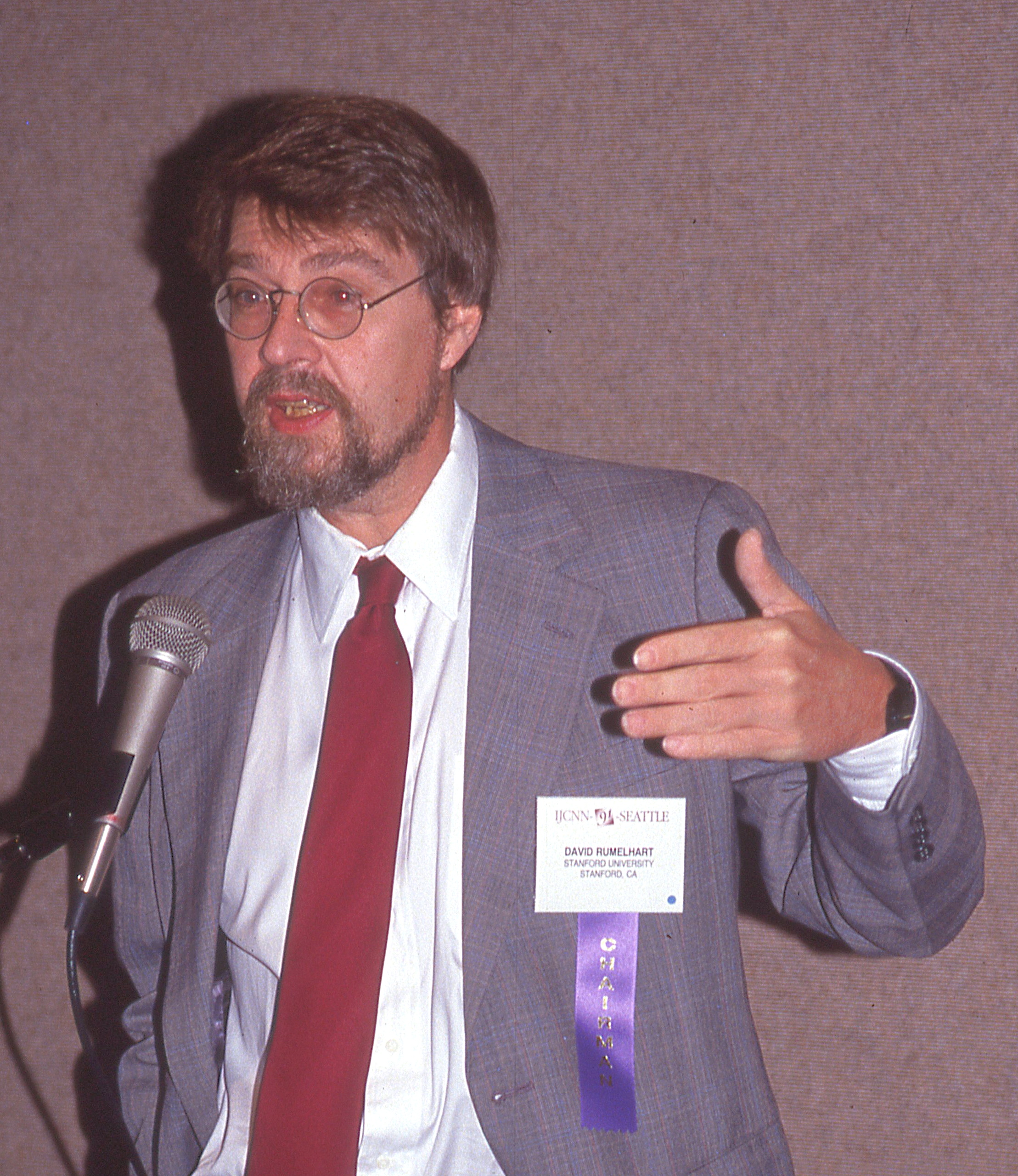
Summary: On October 9, 1986, cognitive psychologist David Rumelhart, alongside his colleagues, published a foundational paper in the journal Nature that provided the essential mathematical framework for training multilayer neural networks, effectively revitalizing the field of connectionism.
In the mid-1980s, the field of artificial intelligence was recovering from a period of stagnation known as an AI Winter 1. On October 9, 1986, in Chicago, Illinois, David Rumelhart and his co-authors fundamentally altered the trajectory of machine learning by demonstrating that computers could learn complex patterns by adjusting the internal connections between simulated "neurons." By formalizing the backpropagation algorithm, they proved that deep, multilayered architectures could be trained efficiently, providing a solution to problems that had previously limited progress since the publication of The Perceptron.
| Historical Attribute | Milestone Registry Value |
|---|---|
| Classification Type | person |
| Chronological Date | 1986-10-09 |
| Coordinates / Location | Chicago, Illinois |
| Curation Authority | Nick Hodder + MIA |
| Milestone Importance | standard Milestone |
How does David Rumelhart fit into the history of artificial intelligence?
David Rumelhart was a central figure in the resurgence of connectionism—a movement that argued intelligence could emerge from the simple, interconnected actions of many small processing units, echoing the McCulloch-Pitts Neural Model. While early pioneers like those at the Dartmouth Workshop focused on symbolic logic, Rumelhart and his collaborators championed the idea that machines should "learn" from data rather than being explicitly programmed with rules. His work effectively countered the skepticism following the Perceptrons Book Published in 1969, which had famously highlighted the limitations of simple neural networks. By showing how hidden layers could be incorporated into a network, he provided the bridge between the simple logic of the 1950s and the sophisticated deep learning systems of the 21st century.
What are the core technical achievements of David Rumelhart?
The primary achievement associated with Rumelhart was the popularization of the backpropagation algorithm, as detailed in the landmark 1986 publication. While the mathematical concept had been described as early as Backpropagation Popularized (and earlier, via Backpropagation Formulated), it was Rumelhart’s specific application to multilayer networks that became the standard. The algorithm functions by calculating the "error" of the network’s output and then distributing that error backwards through the layers to adjust the numerical weights of the connections. By iterating this process thousands of times, the network gradually reduces its error rate until it can accurately classify inputs or predict outcomes. This mechanism proved that a system could self-optimize its own internal structure to perform tasks that previously required human intervention.
Why is the legacy of David Rumelhart significant to modern computing?
The impact of Rumelhart's 1986 research cannot be overstated; it provided the blueprint for virtually every modern AI success. Without the ability to train multilayer architectures, the complex systems that followed—such as the LeNet Digit Classifier and, eventually, modern systems like the The Transformer Paper—would not have been feasible. Rumelhart’s contribution turned "learning" into a stable mathematical process, shifting the industry from a focus on hard-coded heuristics to a focus on data-driven optimization. Today, nearly 100% of state-of-the-art machine learning models rely on variations of the backpropagation process to update their parameters. By shifting the perspective of what a "computer" could do from a mere calculator to a learning machine, Rumelhart set the stage for the era of large-scale neural network training that defines the contemporary technological landscape.