AlexNet Convolutional Net
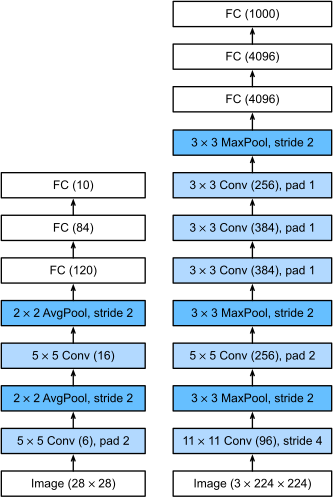
Summary: On September 30, 2012, Alex Krizhevsky, Ilya Sutskever, and Geoffrey Hinton fundamentally transformed the landscape of computer vision by winning the ImageNet Large Scale Visual Recognition Challenge with AlexNet, a deep convolutional neural network that utilized the massive parallel processing power of GPUs to achieve unprecedented accuracy.
In September 2012, researchers in Toronto fundamentally altered the trajectory of artificial intelligence. By applying a deep convolutional neural network to the ImageNet Database Project, the team achieved a top-five error rate of 15.3%, nearly 11 percentage points lower than the closest runner-up. This victory signaled the end of traditional, manually engineered computer vision techniques and marked the explosive beginning of the modern era of deep learning.
| Historical Attribute | Milestone Registry Value |
|---|---|
| Classification Type | software |
| Chronological Date | 2012-09-30 |
| Coordinates / Location | Toronto, Canada |
| Curation Authority | Nick Hodder + MIA |
| Milestone Importance | godfather Milestone |
How does AlexNet Convolutional Net fit into the history of artificial intelligence?
The roots of this milestone extend back to the early concepts of the McCulloch-Pitts Neural Model and the later development of The Perceptron. For decades, the field of connectionism struggled through periods of reduced interest, including the periods identified as the first and second AI Winter 1 and AI Winter 2. While LeNet Digit Classifier and LeNet-5 Convolutional Net established the efficacy of convolutional architectures in the 1980s and 1990s, the hardware of the time could not scale these models to complex, high-resolution color images.
By 2012, the work of researchers like Geoffrey Hinton, Yann LeCun, and Yoshua Bengio had established the foundations of deep architectures. AlexNet acted as the catalyst that proved these theories could be applied to real-world, large-scale data, bridging the gap between historical theoretical neural networks and the practical computational power of modern era hardware.
What are the core technical achievements of AlexNet Convolutional Net?
The primary technical breakthrough of AlexNet was its deliberate design for high-performance computing on hardware accelerators. The model utilized two GeForce GPU Coined cards (NVIDIA GTX 580s) to perform massive matrix operations in parallel. This allowed for the training of a network significantly deeper and wider than previous attempts. It featured five convolutional layers, max-pooling layers, and three fully connected layers.
Crucially, the architecture implemented Rectified Linear Units (ReLU) as activation functions, which solved the Vanishing Gradients Identified problem that had plagued deep networks trained with sigmoid or hyperbolic tangent functions. Additionally, the team utilized Dropout Regularization to prevent overfitting, a technique that forced the network to learn more robust features by randomly ignoring neurons during training. This combination of hardware utilization, novel activation functions, and regularization techniques enabled the network to learn sophisticated, hierarchical visual features from the 1.2 million images provided by the ImageNet training set.
Why is the legacy of AlexNet Convolutional Net significant to modern computing?
The success of AlexNet effectively ended the debate regarding whether deep learning could outperform hand-crafted feature extraction methods in computer vision. Its immediate legacy was a complete shift in the research direction of the entire AI community, leading to the rapid adoption of frameworks like Caffe Framework and the evolution of hardware infrastructure. This momentum directly fueled the development of more complex architectures like ResNet (Residual Networks) and set the stage for large-scale industrial compute resources such as the TPU v1 and the modern NVIDIA H100 GPU.
By demonstrating that sheer scale—in terms of both depth and data—combined with GPU acceleration could solve problems previously deemed intractable, AlexNet provided the empirical validation for the current era of large-scale, deep, and generative modeling. It remains the foundational reference point for the shift from traditional algorithmic programming to data-driven, differentiable programming, proving that computers could "learn to see" provided they were given enough examples and sufficient parallel computational throughput.