TPU v3 Pod
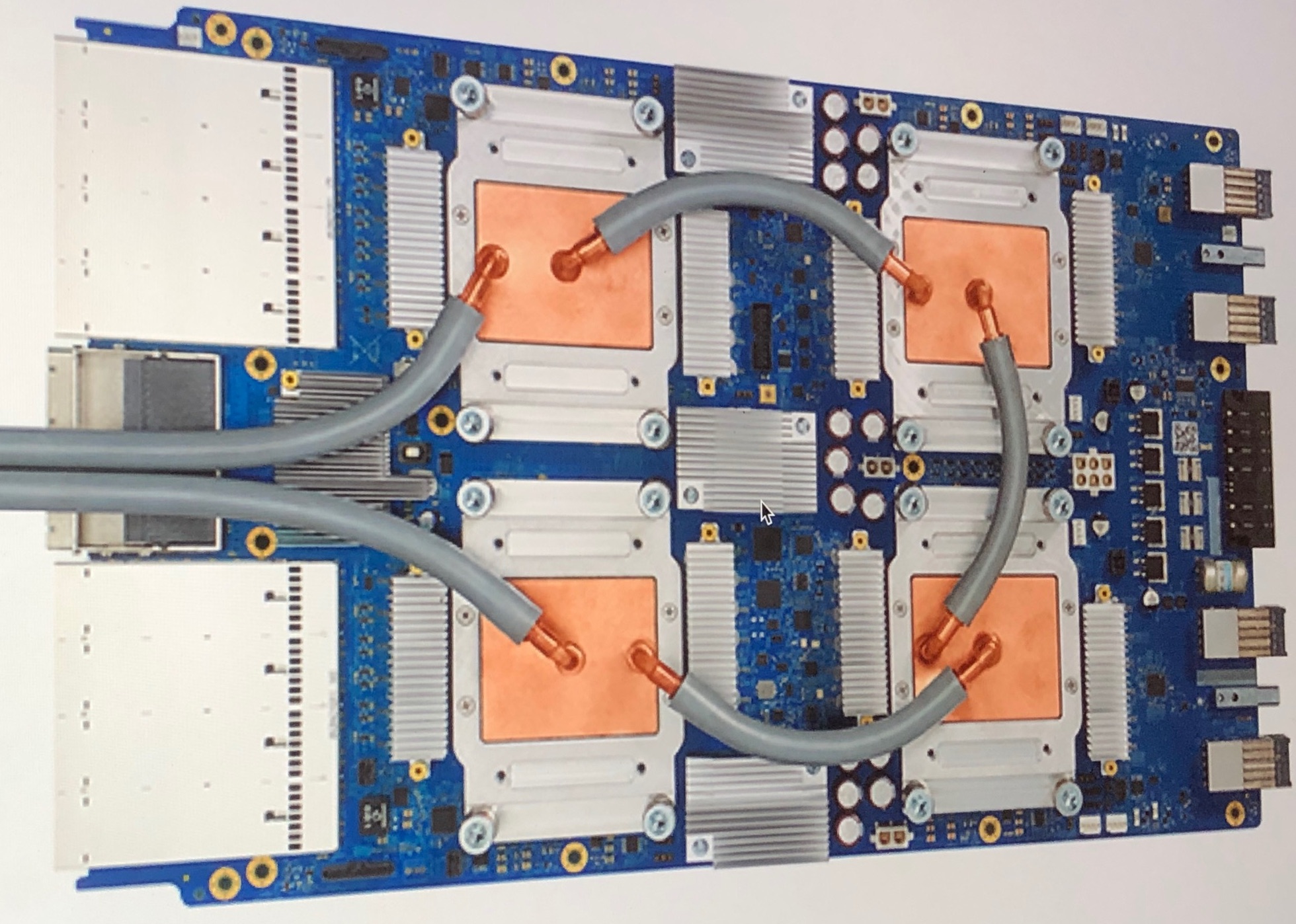
Summary: On May 8, 2018, the unveiling of the TPU v3 Pod marked a definitive shift toward industrial-scale machine learning, introducing sophisticated liquid-cooling technology to sustain the massive power densities required for the next generation of neural transformers.
The deployment of the TPU v3 Pod represents a turning point in hardware history, occurring on May 8, 2018, in Cambridge, Massachusetts. This architecture was designed to address the physical limits of computation, specifically the heat generated when thousands of processors operate in unison to train complex neural networks. By moving from air-cooling to liquid-cooling, engineers were able to pack processing power into a density that was previously impossible, allowing for the training of models with significantly larger parameter counts and more complex architectural requirements.
| Historical Attribute | Milestone Registry Value |
|---|---|
| Classification Type | machine |
| Chronological Date | 2018-05-08 |
| Coordinates / Location | Cambridge, Massachusetts |
| Curation Authority | Nick Hodder + MIA |
| Milestone Importance | standard Milestone |
How does TPU v3 Pod fit into the history of artificial intelligence?
The development of the TPU v3 Pod continues a long trajectory of specialized hardware acceleration. From the early experiments with the SNARC Neural Simulator in 1951 to the modern era of deep learning, there has been a persistent need to optimize computation for the specific mathematics of neural networks. While earlier milestones like the TPU v1 provided a proof of concept for application-specific integrated circuits in machine learning, the TPU v3 Pod scaled this effort to a "pod" level. This shift enabled researchers to move beyond the limitations of standard hardware, such as the DGX-1 Supercomputer, by creating a networked cluster where the hardware acted as a single, massive, unified computing entity.
What are the core technical achievements of TPU v3 Pod?
The primary achievement of the TPU v3 Pod was a 2.7x increase in performance per chip compared to its predecessor, the TPU v2 Pod. However, the most critical engineering feat was the integration of advanced liquid cooling systems. By circulating liquid directly over the chips, the system could maintain stable, high-performance operation at power densities that would cause traditional air-cooled systems to throttle or fail. This allowed for the deployment of pods containing hundreds of interconnected chips, providing over 100 petaflops of total aggregate performance. These clusters provided the raw throughput necessary for advancements in architectures that followed, such as the BERT Language Model and the T5 (Text-to-Text Transformer).
Why is the legacy of TPU v3 Pod significant to modern computing?
The legacy of the TPU v3 Pod is found in the normalization of "compute-as-infrastructure." Before 2018, large-scale training was often limited by the physical constraints of data centers. The success of this pod demonstrated that the bottleneck of artificial intelligence was as much about thermal management and interconnect bandwidth as it was about raw clock speed. This realization paved the way for subsequent developments like the TPU v4 Supercluster and the TPU v6 Supercluster. Furthermore, it underscored the importance of software frameworks like JAX Framework and TensorFlow Platform, which were specifically optimized to orchestrate the immense parallelization that the TPU v3 Pod provided. Without this milestone, the rapid iteration required for models developed in the early 2020s would have been physically impossible to achieve within standard energy and space budgets.