TPU v2 Pod
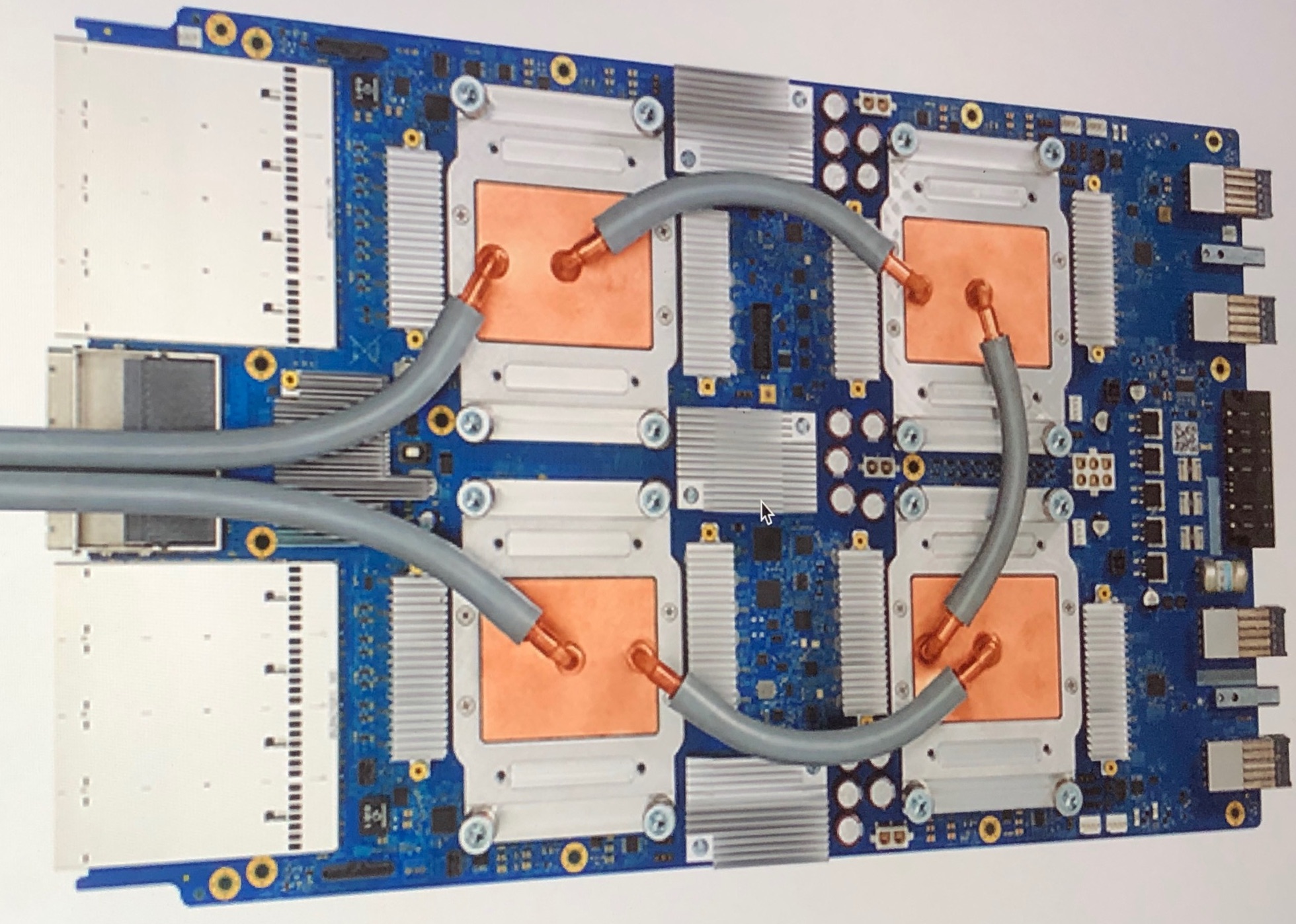
Summary: On May 17, 2017, Google announced the TPU v2 Pod, a custom-built machine learning supercomputer cluster that fundamentally accelerated deep learning by introducing floating-point computational power to handle both the training and inference phases of artificial intelligence model development.
Imagine trying to teach a massive digital brain to read thousands of libraries in mere hours. In the early days of modern artificial intelligence, computers had to learn from mistakes slowly, one step at a time, because their computer chips were not designed to handle the complex, decimal-point mathematics of learning. On May 17, 2017, the announcement of the TPU v2 Pod solved this bottleneck. By linking hundreds of custom-designed processors into a giant, unified supercomputing web in Cambridge, Massachusetts, engineers built an optical highway that allowed these processors to work together as a single, massive computer. This shift allowed neural networks to train themselves in hours rather than weeks, transforming artificial intelligence from a slow research experiment into a fast, scalable utility.
| Historical Attribute | Milestone Registry Value |
|---|---|
| Classification Type | machine |
| Chronological Date | 2017-05-17 |
| Coordinates / Location | Cambridge, Massachusetts |
| Curation Authority | Nick Hodder + MIA |
| Milestone Importance | standard Milestone |
How does TPU v2 Pod fit into the history of artificial intelligence?
To understand the significance of the TPU v2 Pod, one must look at the structural limits of early deep learning infrastructure. Google’s initial custom chip, the TPU v1, was designed exclusively for inference—the phase where a completed, fully trained model processes real-world inputs. It relied on 8-bit integer mathematics, which was highly efficient for execution but mathematically insufficient for the grueling task of training. Training artificial neural networks requires calculating minuscule changes in model parameters, a process called backpropagation, which demands high-precision floating-point numbers. Without these, mathematical rounding errors accumulate, halting the network's ability to learn.
Before 2017, the AI community relied heavily on graphics processing units (GPUs) originally built for rendering video games. While GPUs excelled at parallel processing, they were constrained by slow server-to-server communication bottlenecks and high power consumption when scaled to massive clusters. High-profile milestones like AlphaGo vs Lee Sedol demonstrated that state-of-the-art breakthroughs required staggering amounts of hardware coordination.
By introducing the TPU v2 Pod, engineers integrated software, hardware, and networking into a single domain-specific supercomputer. Designed in tandem with the TensorFlow Platform, this machine marked the exact historical moment where silicon design ceased to be a general-purpose endeavor and instead became explicitly optimized for the mathematical structures of deep neural networks.
What are the core technical achievements of TPU v2 Pod?
The core of the TPU v2's performance lay in its novel architectural choices, most notably the creation of the **bfloat16** (Brain Floating Point) numeric format. Traditionally, scientific computing relied on IEEE 754 single-precision (FP32) or half-precision (FP16) floating-point standards. While FP32 offered the wide dynamic range needed for training gradients, it consumed vast memory bandwidth and silicon area. Conversely, FP16 reduced energy use but had a narrow dynamic range, frequently causing training runs to crash due to numeric overflow or underflow.
Google’s engineers bypassed this trade-off by designing bfloat16, which used 16 bits of storage but retained the exact same 8-bit exponent size as FP32, simply truncating the fraction (mantissa) to 7 bits. This preserved the dynamic range of FP32 while slashing memory footprint and hardware complexity. It allowed the TPU v2's Matrix Multiply Units (MXUs) to process massive data volumes without loss of stability during backpropagation.
Each TPU v2 chip featured two independent cores, each housing an MXU capable of processing 128x128 mixed-precision matrix operations per clock cycle. A single TPU v2 board grouped four of these chips, yielding 180 teraflops of performance and 64 gigabytes of High Bandwidth Memory (HBM2) boasting a transfer rate of 2.4 terabytes per second.
The defining leap, however, was the scaling architecture of the "Pod." Rather than clustering machines through standard PCIe buses and external Ethernet switches, Google built a custom 2-D toroidal mesh network directly into the TPU v2 boards. Each Pod linked 64 TPU v2 boards (256 chips total) over a direct, ultra-low-latency optical interconnect. This allowed the entire cluster to function as a singular 11.5-petaflop supercomputer, enabling model parallelization across hundreds of chips without the typical software orchestration bottlenecks.
Why is the legacy of TPU v2 Pod significant to modern computing?
The TPU v2 Pod established a new blueprint for computational scale that continues to dictate how advanced artificial intelligence is built. By dramatically accelerating training iterations from weeks to hours, it provided the direct physical sandbox required to develop complex architectures. Most notably, the launch of the TPU v2 Pod occurred in the same period that researchers authored The Transformer Paper. The transformer's highly parallelizable attention mechanisms were perfectly aligned to exploit the direct matrix-multiplication pipelines of the TPU v2, creating a profound feedback loop between hardware design and algorithmic breakthroughs.
The system's architectural success ignited an industry-wide hardware race. NVIDIA responded by integrating dedicated Tensor Cores into its enterprise hardware, eventually leading to massive cluster-scale solutions like the DGX-1 Supercomputer and the NVIDIA H100 GPU architectures. Meanwhile, the validation of bfloat16 was so complete that the format was adopted as a global standard across CPUs, GPUs, and specialized hardware alike.
Within Google’s own development timeline, the TPU v2 Pod paved the way for subsequent scaling efforts, including the water-cooled TPU v3 Pod and the highly advanced TPU v4 Supercluster. These systems went on to train foundational models like the BERT Language Model. Alternative computing companies also adopted similar philosophies of unified, clustered chip architectures, such as the wafer-scale Cerebras CS-1 System. Ultimately, the TPU v2 Pod was the milestone that proved that deep learning was not merely a software challenge, but a physical scaling problem that required custom, network-switched silicon arrays to unlock the true potential of neural networks.