Seq2Seq Architecture
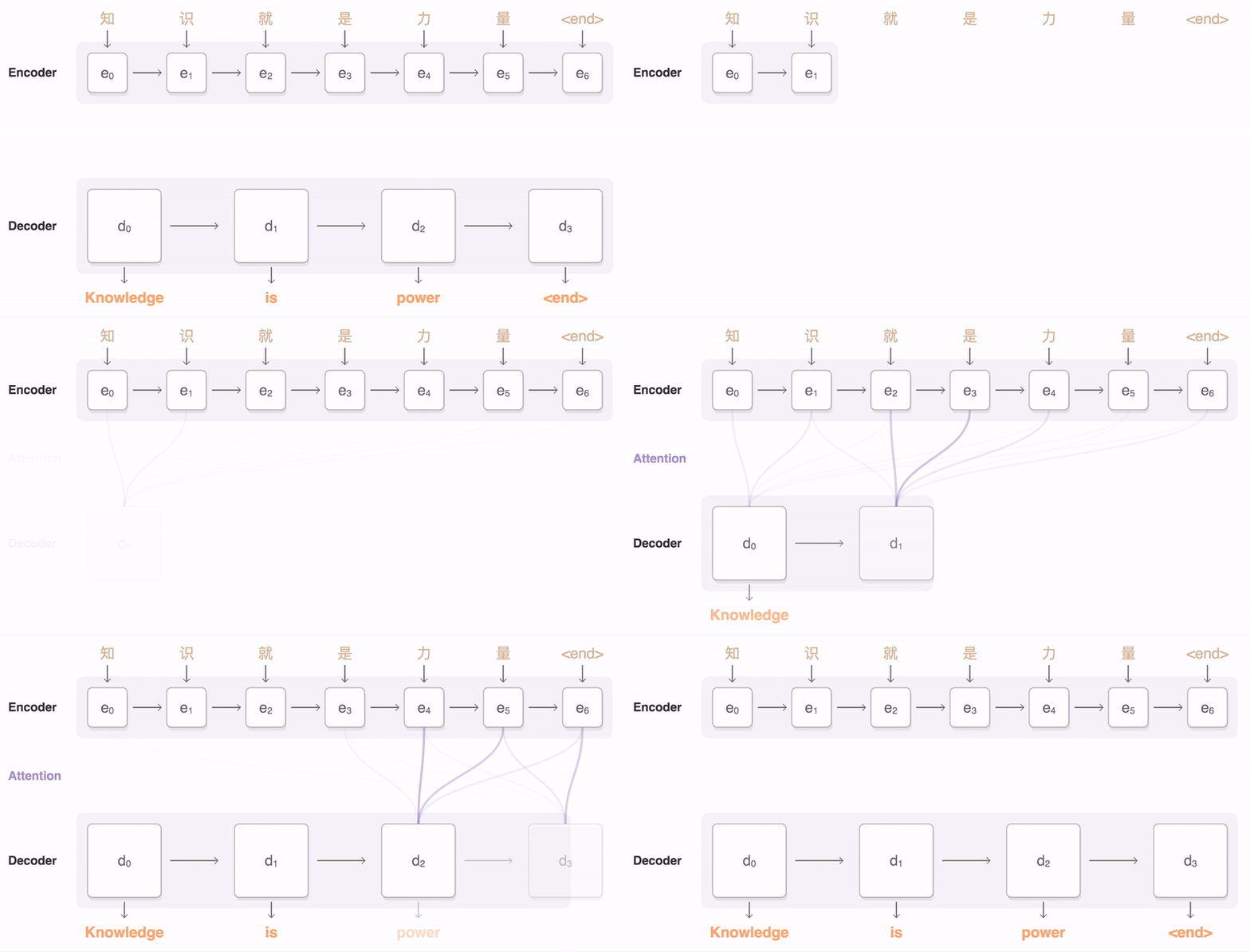
Summary: On September 10, 2014, researchers Ilya Sutskever, Oriol Vinyals, and Quoc Le fundamentally transformed machine translation by introducing the Sequence to Sequence (Seq2Seq) model, a groundbreaking software architecture that enabled computers to translate variable-length input sequences into corresponding output sequences with unprecedented fluency.
The Seq2Seq architecture, introduced in 2014 in Mountain View, California, solved a persistent limitation in computational linguistics: how to map an input of one length, such as a sentence in French, to an output of a different length, such as its translation in English. By utilizing an encoder-decoder framework, this model provided a universal method for transforming data sequences, marking a departure from rigid, rule-based systems toward flexible, neural-network-driven machine learning.
| Historical Attribute | Milestone Registry Value |
|---|---|
| Classification Type | software |
| Chronological Date | 2014-09-10 |
| Coordinates / Location | Mountain View, California |
| Curation Authority | Nick Hodder + MIA |
| Milestone Importance | standard Milestone |
How does Seq2Seq Architecture fit into the history of artificial intelligence?
The development of Seq2Seq emerged from the ongoing refinement of Backpropagation Popularized techniques and follows the lineage of Neural Language Modeling. Before 2014, machine translation relied heavily on statistical models that struggled with word order and long-distance dependencies. By the time AlexNet Convolutional Net had proved the efficacy of deep learning on large datasets, the research community was seeking similar breakthroughs in natural language processing. Seq2Seq bridged this gap by demonstrating that deep neural networks could successfully process entire sentences as units of data, rather than individual words, building upon earlier work such as Long Short-Term Memory to handle sequential context effectively.
What are the core technical achievements of Seq2Seq Architecture?
The architecture consists of two main components: an encoder and a decoder. The encoder processes the input sequence and compresses the information into a fixed-length vector, often referred to as a "context vector" or a latent representation. The decoder then utilizes this vector to generate the output sequence. One of the primary technical achievements was the utilization of multi-layered Long Short-Term Memory cells, which allowed the model to maintain information over longer sequences, mitigating the Vanishing Gradients Identified issues that plagued previous neural network designs. In experimental benchmarks, the system achieved significant improvements in translation accuracy compared to conventional phrase-based systems, demonstrating that deep architectures could outperform specialized, hand-engineered heuristic models.
Why is the legacy of Seq2Seq significant to modern computing?
The influence of Seq2Seq is pervasive in the subsequent evolution of AI. By establishing that sequence-to-sequence mapping was a viable paradigm, it set the stage for later breakthroughs, most notably The Transformer Paper, which replaced recurrent mechanisms with attention mechanisms. The methodology pioneered in 2014 remains the foundational blueprint for modern generative architectures, including GPT-3 Language Model and T5 (Text-to-Text Transformer). The shift toward mapping high-dimensional inputs to outputs is the reason why current software can perform complex tasks ranging from summarization to code generation. The 2014 publication fundamentally changed the trajectory of the field, cementing the role of deep learning as the primary engine for sequence-based data processing across the global technology ecosystem.