Alan Turing
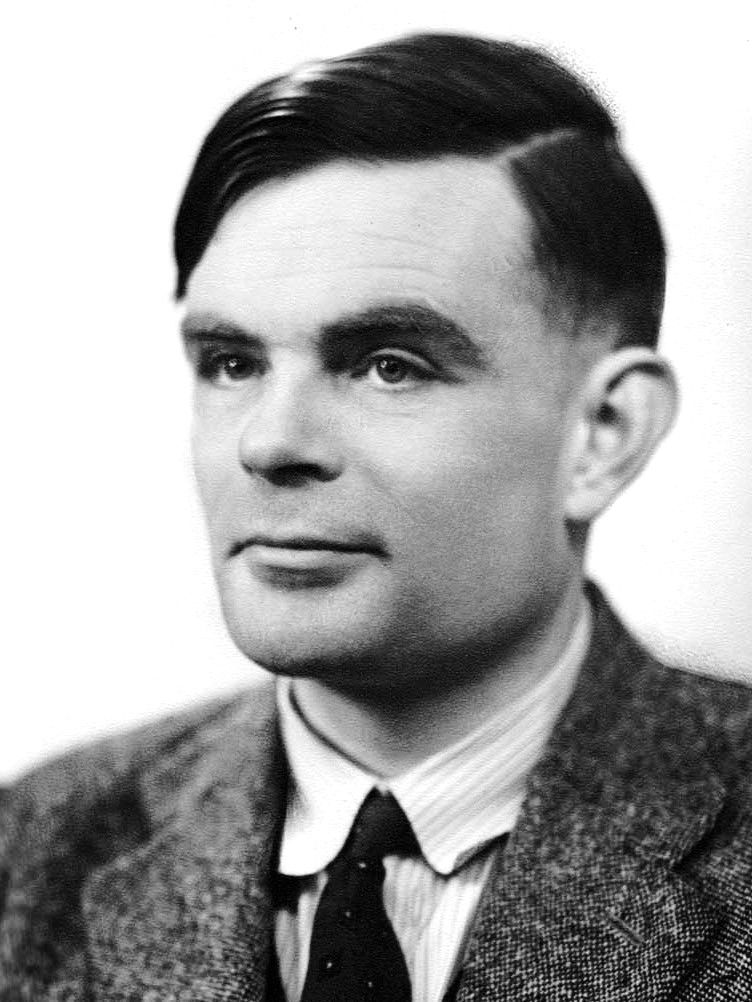
Summary: On November 12, 1936, British mathematician Alan Turing published his pioneering paper "On Computable Numbers, with an Application to the Entscheidungsproblem," introducing the concept of the universal computing machine and establishing the mathematical limits of what machines can logically calculate.
In November 1936, a young British mathematician named Alan Turing solved a profound mathematical riddle at the University of Cambridge. He did this not by building a physical device, but by imagining a simple mechanism that could read and write marks on an endless strip of paper tape. This conceptual device, now called a Turing Machine, proved that some math problems can never be solved by a step-by-step set of rules, while simultaneously proving that a single, programmable machine could perform any mathematical calculation. This foundational idea unlocked the transition from rigid, single-purpose calculators to flexible, programmable software, establishing the theoretical framework for modern computer science and artificial intelligence.
| Historical Attribute | Milestone Registry Value |
|---|---|
| Classification Type | person |
| Chronological Date | 1936-11-12 |
| Coordinates / Location | Cambridge, UK |
| Curation Authority | Nick Hodder + MIA |
| Milestone Importance | godfather Milestone |
How does Alan Turing fit into the history of artificial intelligence?
Before machines could be made intelligent, humanity first had to define what it meant to calculate. In the nineteenth century, pioneers like Ada Lovelace and Charles Babbage designed the Analytical Engine, the earliest conceptualization of a general-purpose mechanical computer. However, their work lacked a formal mathematical proof of the boundaries of computation. Alan Turing provided this exact missing link in 1936. By mathematically defining an "algorithm," Turing answered what is logically possible for a mechanical system to achieve.
This definition of mechanical computation directly paved the way for cognitive modeling and neural networks. If the human brain is a physical system governed by physical laws, and physical laws can be modeled by algorithms, then the brain itself can be simulated on a universal machine. This realization profoundly influenced Warren McCulloch and Walter Pitts, who relied on Turing's logic to formulate the McCulloch-Pitts Neural Model in 1943. By demonstrating that networks of simplified biological neurons could compute any logical function, they bridged the gap between biological thought and Turing's universal machines.
Turing's 1936 paper did not merely predict the hardware of the future; it anticipated the software structures required for synthetic intelligence. Having defined the limits of mathematical computation, Turing spent the subsequent decade exploring the limits of machine thought. This journey culminated in 1950 when he published "Computing Machinery and Intelligence," where the Turing Test Proposed shifted the philosophical debate from whether machines could possess "souls" or "minds" to whether they could successfully imitate human linguistic behavior.
What are the core technical achievements of Alan Turing?
The core of Turing’s 1936 paper was a direct assault on David Hilbert’s *Entscheidungsproblem* (the Decision Problem), which asked whether an automated, step-by-step mathematical method could always determine if a given assertion is provable. To address this, Turing created a rigorous mathematical model of a person executing a calculation. He stripped this human "computor" down to the barest functional mechanics: an observer with a finite set of mental states, looking at a paper divided into squares, reading one symbol at a time, and writing or erasing symbols based on a fixed set of rules.
This idealized system, the Turing Machine, consists of three core elements:
- An Infinite Tape: A paper tape divided into discrete squares, serving as an unlimited memory storage. Each square can hold a symbol from a finite alphabet (such as
0and1). - A Read/Write Head: A mechanism that moves left or right along the tape, reading the symbol in the current square, modifying it, or erasing it.
- A Transition Table (Control Unit): A finite state machine that determines the next step. Based on the current internal state of the machine and the symbol currently read on the tape, the machine will write a new symbol, move the head one step left or right, and transition to a new internal state.
Turing’s true stroke of genius was the *Universal Turing Machine* (UTM). He realized that a Turing machine's table of rules could itself be encoded as a sequence of symbols (a program) and written onto the tape of a second, generalized Turing machine. This UTM would read the program from its tape and simulate the behavior of the encoded machine on the provided input data. This concept of storing programs and data in the same memory space is the very definition of the "stored-program computer" architecture.
Using this formal definition, Turing proved the existence of the "Halting Problem." He demonstrated mathematically that it is impossible to write a general algorithm that can pre-determine whether any arbitrary program will eventually finish running or run forever in an infinite loop. This elegant proof of uncomputability delivered a decisive negative answer to Hilbert’s Decision Problem and defined the absolute boundary of what any mechanical computer can ever resolve.
Why is the legacy of Alan Turing significant to modern computing?
Turing’s theoretical formulations catalyzed the rapid development of electronic computation during the 1940s. His insights into algorithms and logic were put into practice during World War II at Bletchley Park, where he designed the electromechanical Bombe to crack the German Enigma cipher, indirectly influencing the development of the British vacuum-tube Colossus Computer. Following the war, his work directly shaped the creation of early stored-program digital computers, including the American eniac" class="text-accent hover:underline font-semibold">ENIAC and the proposed EDVAC Computer designed by John von Neumann, who openly acknowledged that the conceptual foundation of his architecture came directly from Turing's 1936 paper.
When the AI Term Coined at the historic Dartmouth Workshop in 1956, the mathematical logic of the Turing machine served as the foundation for the entire discipline. Early symbolic AI architectures, such as the Logic Theorist and the heuristic-based Samuel Checkers Program, were physical executions of Turing's universal machines programmed with rules for search and deduction.
Furthermore, the theoretical boundaries established by Turing in 1936 remain the standard yardstick for computational power. In linguistics and cognitive science, Noam Chomsky utilized Turing's hierarchy of computation when the Chomsky Hierarchy Formulated in 1956, placing Turing machines at the pinnacle of grammatical complexity. Today, whether a system is a massive modern neural network, a quantum computer, or a simple calculator, it is fundamentally bound by Turing’s limits of computability. The 1936 paper remains a towering monument, marking the exact moment humanity formalized the laws of computation and began its journey to construct an artificial mind.