Shakey the Robot
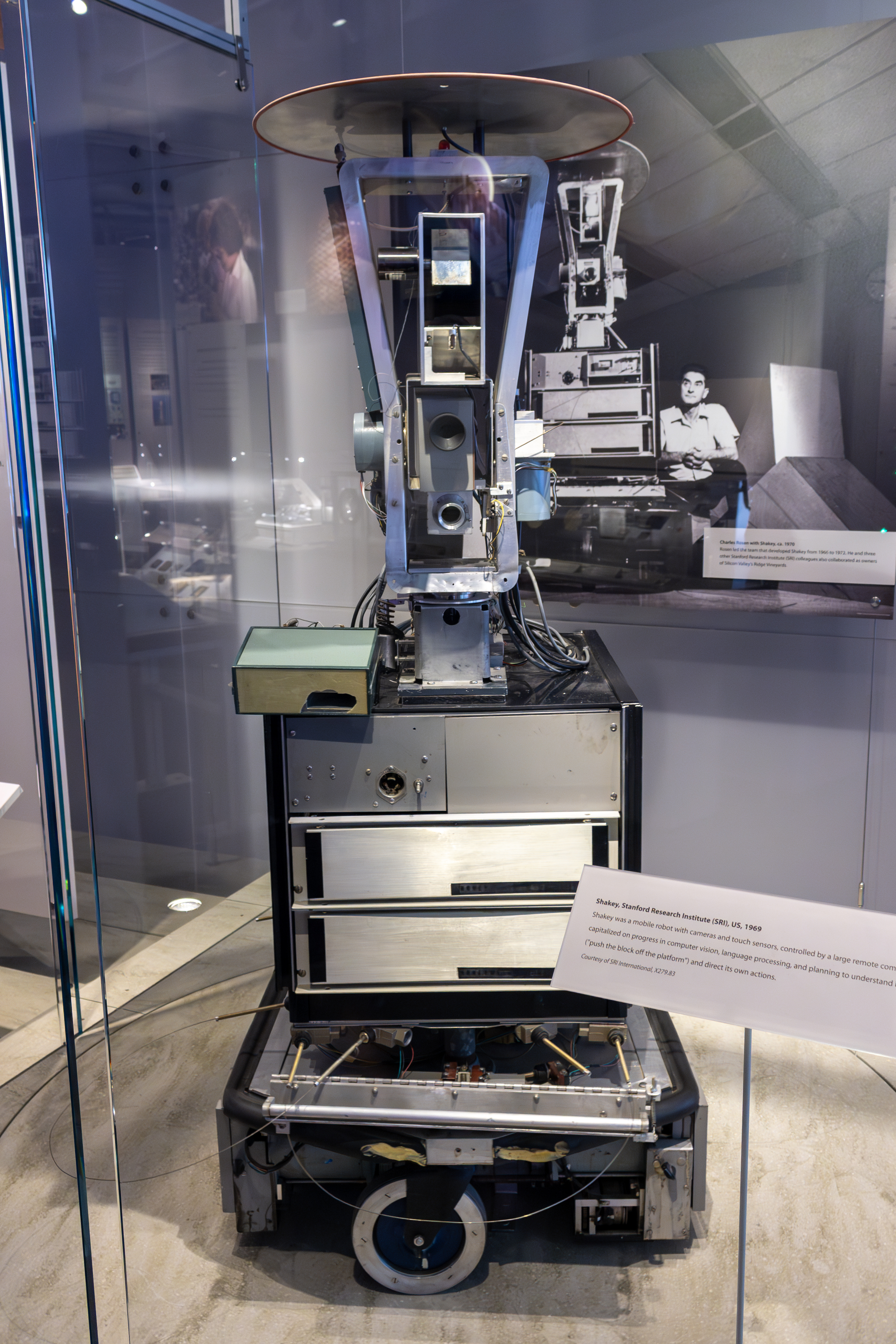
Summary: On October 1, 1968, researchers at the Stanford Research Institute officially demonstrated Shakey the Robot, the world’s first mobile, autonomous machine capable of observing its environment, formulating logical plans, and executing physical actions to solve complex tasks.
In the autumn of 1968, in Menlo Park, California, a team of pioneering engineers at the Stanford Research Institute (SRI) unveiled Shakey the Robot. Standing as a monument of early computer science, Shakey was the very first physical machine capable of merging computer vision, logical reasoning, and physical navigation. To make sense of its surroundings, Shakey used a clever mathematical shortcut to find the best paths around obstacles—an approach that birthed the famous A* pathfinding algorithm. For a non-technical observer, Shakey’s operation resembled a person navigating a cluttered room: it looked at the obstacles, calculated the safest route, and pushed blocks into place, laying the foundation for modern robotics and self-driving technologies.
| Historical Attribute | Milestone Registry Value |
|---|---|
| Classification Type | machine |
| Chronological Date | 1968-10-01 |
| Coordinates / Location | Menlo Park, California |
| Curation Authority | Nick Hodder + MIA |
| Milestone Importance | godfather Milestone |
How does Shakey the Robot fit into the history of artificial intelligence?
Before Shakey’s development, early artificial intelligence was largely disembodied. Early computer programs, such as the Logic Theorist and the General Problem Solver, excelled at abstract mathematical puzzles or proving logical theorems, but they lacked any physical presence. When computers did interact with the physical world, they did so as stationary, pre-programmed industrial machinery, exemplified by the Unimate Industrial Robot, which could only blindly repeat precisely recorded geometric coordinates without understanding its environment.
Shakey bridged the gap between pure symbol-processing software and physical reality. Inspired by theoretical visions ranging from Alan Turing to the science-fiction frameworks of the Three Laws of Robotics, the SRI team sought to build a system that could perceive, reason, and act within a dynamic physical space. This ambition was heavily supported by the Defense Advanced Research Projects Agency (DARPA), which sought to apply the symbolic paradigms established at the Dartmouth Workshop to tangible machinery. While projects like the Stanford Cart were experimenting with remote control and basic camera feeds, Shakey represented the first fully integrated attempt to build a logical mind inside a mobile physical chassis.
What are the core technical achievements of Shakey the Robot?
Physically, Shakey was a towering, wheeled machine equipped with a television camera, a triangulating optical rangefinder, and cat-whisker bump sensors. The robot was nicknamed "Shakey" due to the violent wobbling that occurred as it stopped, turned, and processed information. Because onboard computers of the late 1960s were far too heavy and power-hungry to be carried on a mobile frame, Shakey communicated via a radio link with an SDS-940 mainframe computer running programs written in the LISP Programming Language.
The true genius of Shakey lay in its layered software architecture, which was split into hierarchical levels of abstraction. At the lowest level were simple motor commands like "roll forward" and "rotate camera." At the highest level sat STRIPS (Stanford Research Institute Problem Solver), a planning engine that utilized formal logic to construct action plans. If a user commanded Shakey to move a red wooden block from one room to another, STRIPS would analyze the robot's current state, outline the goal state, and generate a step-by-step sequence of sub-tasks to achieve it.
To navigate between rooms and around obstacles without getting stuck or taking unnecessarily long paths, the team developed the A* search algorithm in 1968. Designed by Peter Hart, Nils Nilsson, and Bertram Raphael, A* combined the step-by-step path calculation of Dijkstra's algorithm with a heuristic estimate of the remaining distance to the goal. This mathematical breakthrough allowed Shakey to rapidly determine the mathematically shortest path through its environment, avoiding the exponential calculation delays that crippled earlier search methods.
Why is the legacy of Shakey the Robot significant to modern computing?
The immediate impact of Shakey was both inspiring and highly polarizing. While it proved that a machine could navigate the real world using symbolic logic, its operational speed was glacial. A simple task, such as pushing a block into an adjacent room, could take Shakey several hours to execute, as it spent up to 95% of its time sitting stationary, processing visual edges and calculating logical permutations. This physical clunkiness and high computational cost contributed directly to the rising skepticism of symbolic AI, which eventually culminated in the onset of the first AI Winter 1.
This computational bottleneck later inspired roboticists like Rodney Brooks to reject Shakey's heavy "sense-model-plan-act" framework in favor of the decentralized Subsumption Architecture, which allowed robots to react instantly to sensory input without complex central planning.
Despite these early criticisms, Shakey's technological DNA remains omnipresent in modern technology. The A* algorithm, originally engineered to guide Shakey through physical doorways, remains the gold standard pathfinding algorithm utilized in modern video game design, global logistics networks, and digital map routing. Decades after Shakey's initial physical roll-out, its fundamental systems-integration approach directly paved the way for successful commercial applications, ranging from the Roomba Consumer Robot to the competitive breakthroughs of the DARPA Grand Challenge 2004 and the autonomous Stanley Autonomous SUV. By demonstrating that logical deduction could govern mechanical movement, Shakey permanently transformed robotics from a discipline of rote engineering into an active branch of artificial intelligence.